Flex Classic on Bare Metal
Dalet Flex is fully compatible traditional Bare Metal hosting.
Whether it is on-premises, collocated (e.g. Equinix) or on-cloud on dedicated servers (e.g. OVHcloud, Hetzner, ...), running Flex on metal is probably the most economical way to get the best performance/price ratio.
The opposite is true as well, being very static and probably the hardest way to easily and timely scale up.
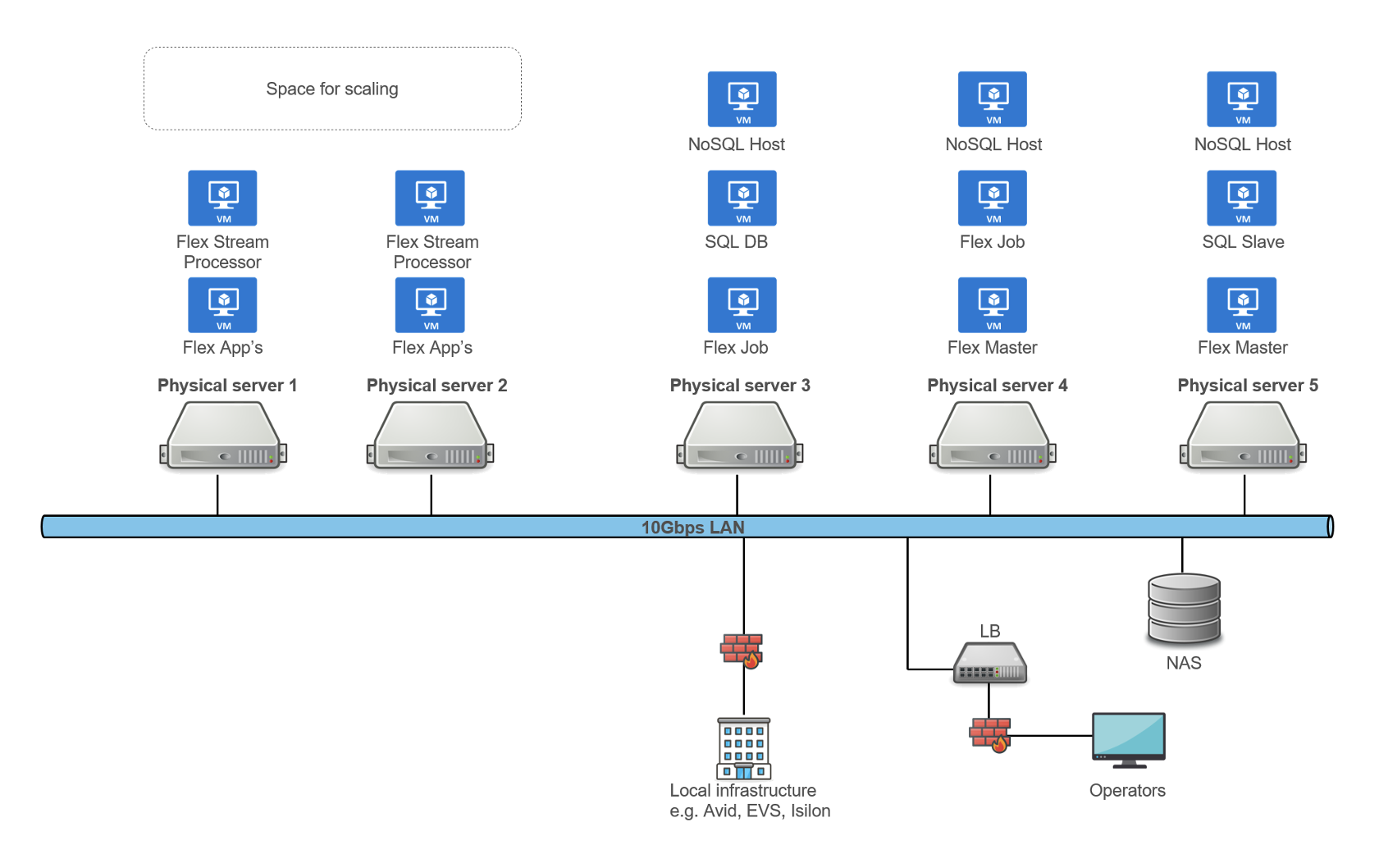
When on metal, there's no added-value 'as-a-service' thing one can use. Every service will come bundled within Flex application.
A typical deployment consist of multiple physical servers: the more the better (but the more expensive it will be). Flex services will be distributed amongst the various metal servers. How you spread them depends on the number of machines you have and your security policy.
Because some application require to run in cluster, the minimal amount of metal servers you'd need is 3, no matter what.
But having at least 5 metal servers would be a more careful recommendation.
Compared to virtual machines, metal servers have a different lifecycle and may require more maintenance and reboot operations. Each server will handle (N-M)/N % of the global workload, where:
- N is the number of metal servers you have.
- M is the amount of metal servers you expect being able to be down simultaneously with a resilient system.
So for a 5 servers cluster, considering that only one can get down at a given time (e.g. forced maintenance), each server has a maximum nominal resource usage capability of 80%. If you go above this threshold, you won't be able to operate high-availability should anything arise.
It is more than recommended to use enterprise-grade servers:
- More CPU and memory than what you'd need: because sometimes (e.g. with databases) horizontal scale up is not possible and your current hardware's resources become your application bottleneck.
- 2x 25+ Gbps NICs (with 802.1Q bonding) for private network interface.
- 2x 10 Gbps NICs (with 802.1Q bonding) ofr public network interface (if/when required).
- Blazing-fast NVME SSDs with RAID mirroring.
- 2x hot-pluggable PSU.
- Ideally, hot-pluggable CPU and memory banks.
- Always order spare parts to have them ready when required.
Hos you spread Flex micro-services amongst the various servers is operator's responsibility. The Master, App, Job, Services and other kind of instance profiles can all be mutualized. It is up to you to decide where you each workload should physically run.
This depends on the amount of metal servers you have and the IT and security policy in place.
For example, it'd be hard to limit yourself to 3 or 5 metal servers if you expect to have dedicated load-balancers (i.e. Internet-facing machines) distinct from your 3-nodes databases cluster.